

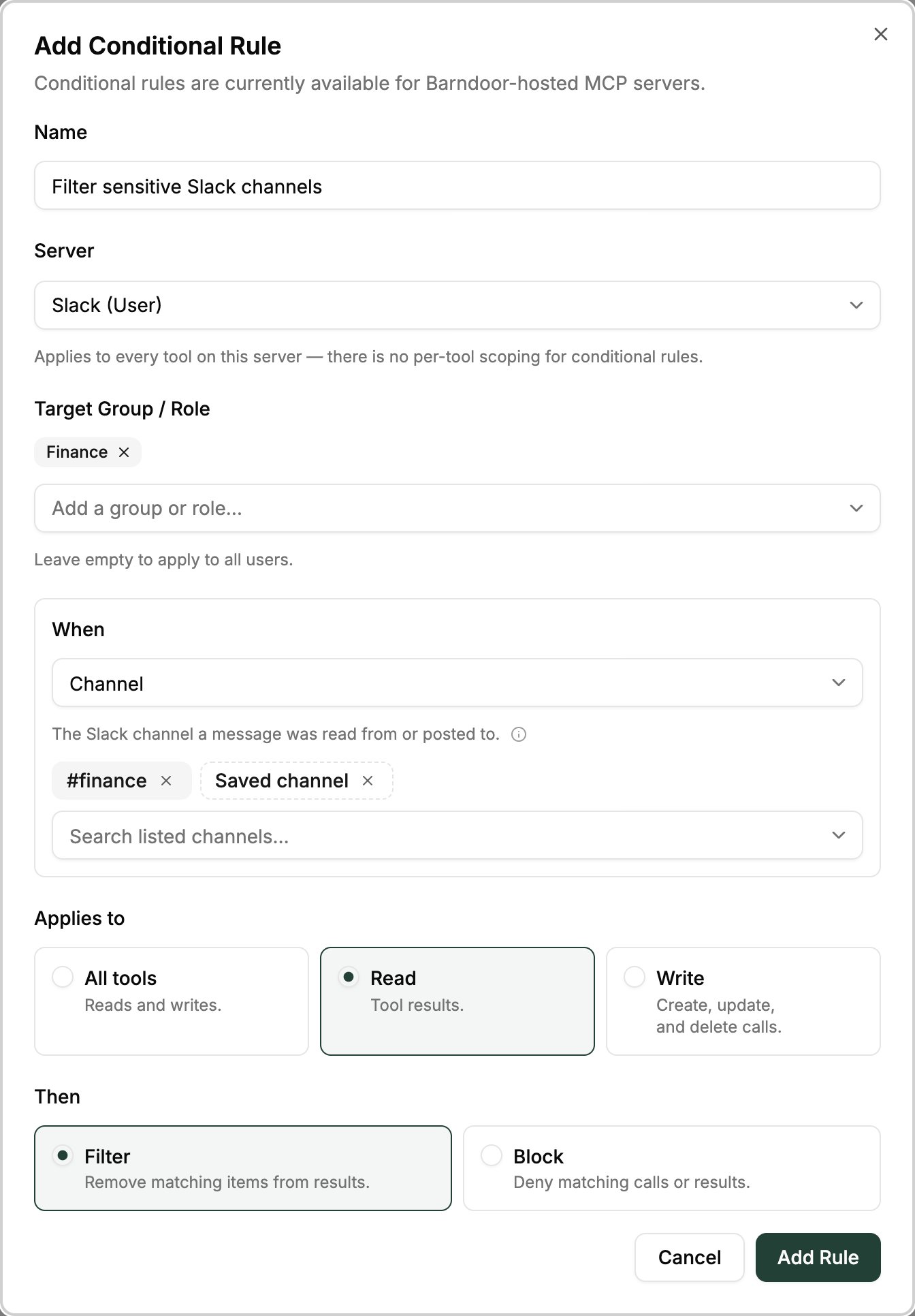
#finance when the Support group reads Slack, or stop
agents from posting to externally shared channels.
Setup has two steps:
- Connect the Slack (User) MCP server in Barndoor so it can list your workspace’s channels.
- Create the conditional rule in Field Controls.
Prerequisites
You need:- Admin access to your Barndoor organization
- A Slack user who can see the channels you want to govern
1. Connect the Slack (User) MCP server
In this guide, service account means the organization-level OAuth
connection on the Barndoor server detail page. Barndoor uses it to list your
workspace’s channels when you build a rule.
- Navigate to Admin → MCP Servers.
- Add Slack (User) from the Barndoor-hosted MCP server directory, or open an existing Slack (User) server.
- On the server detail page, connect the service account with a Slack user who can see the channels you want to govern. The channel list includes the public and private channels that user can see, including archived channels.
2. Create the conditional rule
With the service account connected, you can build the rule.- Navigate to Data Control Center → Field Controls.
- Click Add Conditional Rule.
- Enter a Name and select your Slack (User) server under Server. The rule applies to every tool on the server.
- Optionally, add groups or roles under Target Group / Role. Leave it empty to apply the rule to all users.
- Under When, choose a condition:
- Channel: specific channels. See Choose channels.
- Channel type: every channel of a kind. See Choose channel types.
- Under Applies to, choose All tools, Read (tool results), or Write (create, update, and delete calls).
- Under Then, choose Filter to remove matching items from results, or Block to deny matching calls or results. Filter isn’t available for Write: writes are always blocked outright.
- Click Add Rule.
Choose channels
Search the list of channels from your workspace and select one or more. You can also type a channel name, or a wildcard pattern such asproj-* or *-prod,
for channels that aren’t listed.
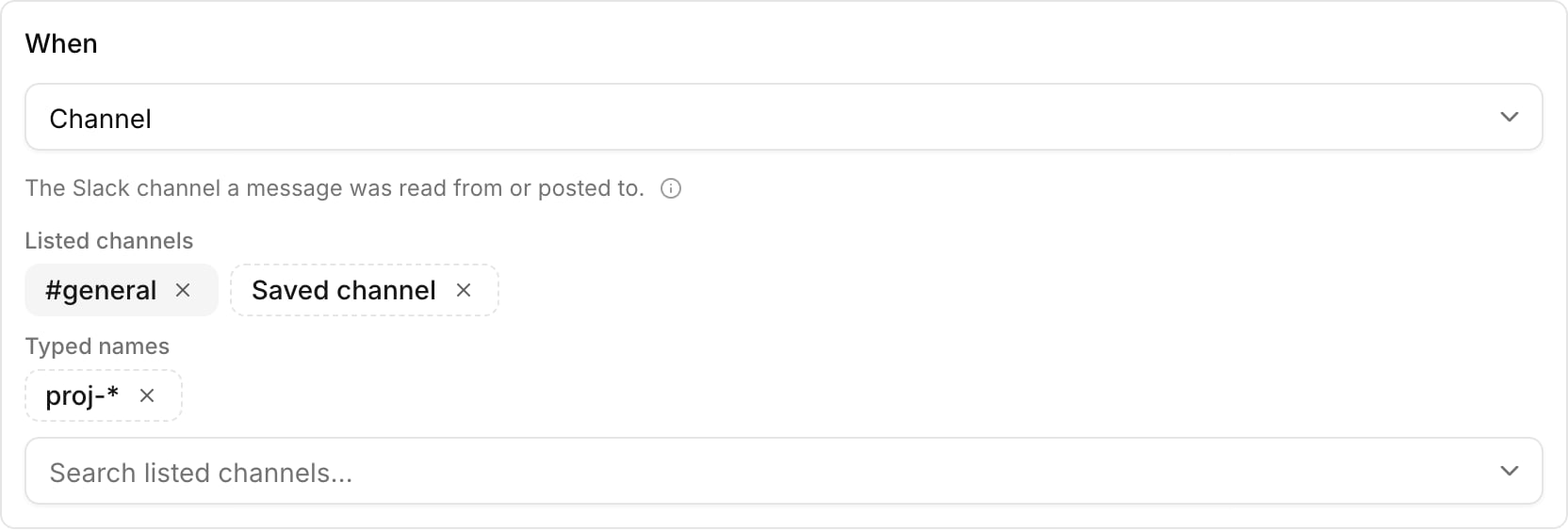
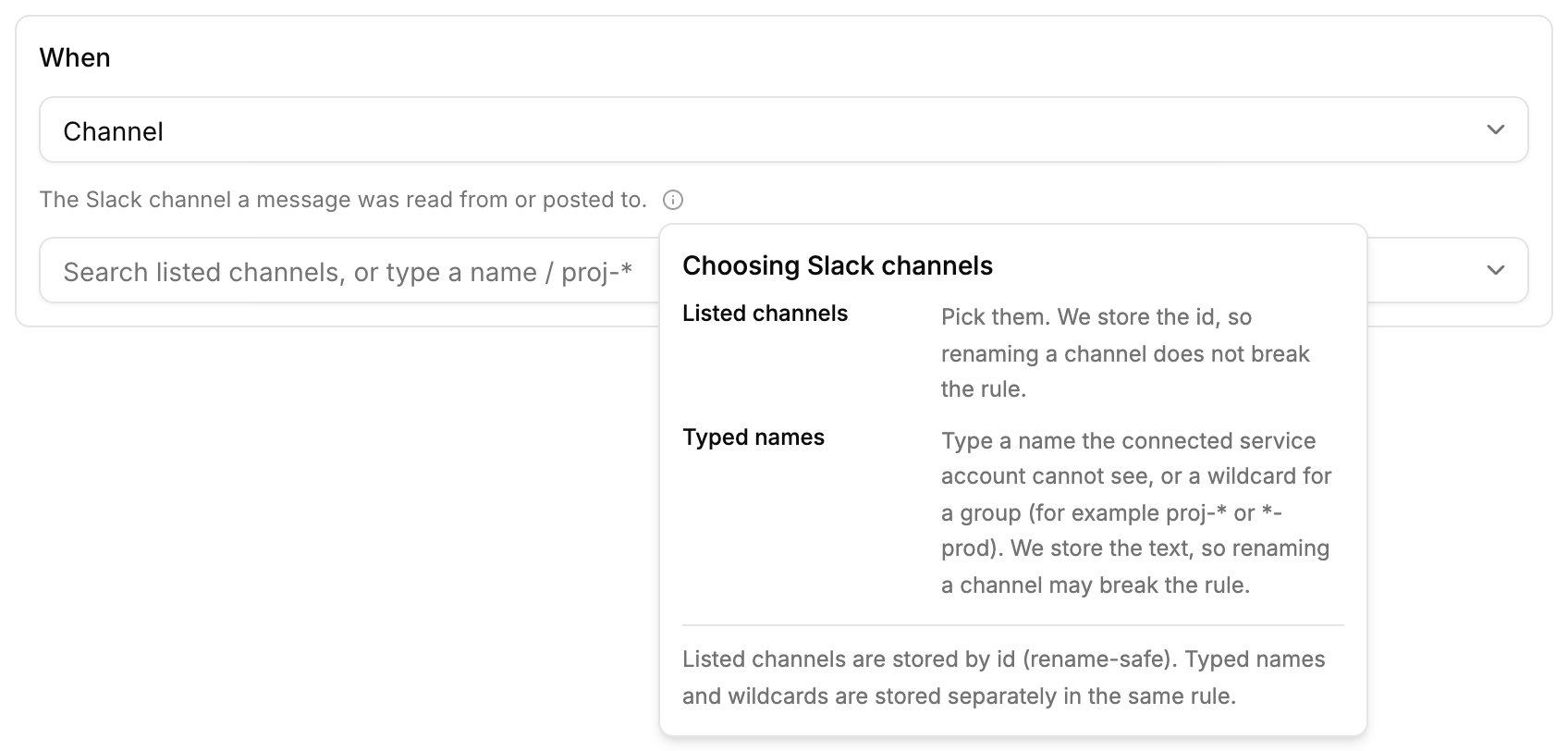
Pick from the list where you can. If you type the name of a channel that is
listed, Barndoor uses the listed channel’s ID instead. Typed names are for
channels the service account can’t see. Hover the info icon next to the
condition description for a reminder:
- Pasted Slack IDs or channel links. Pick the channel from the list, or type its name.
- A wildcard on its own, such as
*. To cover every channel of a kind, use a Channel type rule instead.
Large workspaces can take a moment to load. Barndoor loads up to 2,000
channels. If the list isn’t complete, the When section says so. Search
it, or type the name of a channel that isn’t shown.
Choose channel types
Channel type matches every conversation of the kinds you select:
Each conversation has exactly one type. When more than one applies, the first
match in this order wins: Externally shared, then Direct message or
Group DM, then Private channel, then Public channel. For example, a
private channel shared with a partner organization is Externally shared,
so a Private channel rule doesn’t match it. Select both types to cover it.
What a rule matches
- Read checks the channels, messages, and files that Slack tools return. Filter removes matching items and returns the rest. Block denies the whole result if any item matches.
- Write checks where a message is posted. Before the message is sent, Barndoor looks up the target channel and blocks the post if it matches.
- All tools applies both checks.
Examples
Hide finance channels from the Support group:- When: Channel is
#finance,#finance-ops - Applies to: Read
- Then: Filter
- Target Group / Role:
customer-support
- When: Channel type is Externally shared
- Applies to: Write
- Then: Block
- When: Channel is
proj-*(typed wildcard) - Applies to: All tools
- Then: Block
Troubleshooting
A channel is missing from the list
A channel is missing from the list
The list only shows channels the connected service account can see, up to
2,000 channels. Type the channel name instead, or reconnect the service
account with a Slack user who is a member of that channel.
"Pasted Slack ids are not saved"
"Pasted Slack ids are not saved"
Barndoor doesn’t save channel IDs or links that you paste. Pick the channel
from the list, or type its name.
"That looks like a Slack ID"
"That looks like a Slack ID"
The value you typed looks like a Slack channel ID. Type a lowercase channel
name such as
proj-*, or pick the channel from the list."To cover every channel, use a Channel type rule"
"To cover every channel, use a Channel type rule"
A wildcard on its own, such as
* or #*, isn’t accepted. Create a rule
with When set to Channel type and select the kinds of channel to
cover.